

The Secret to Coding with AI: Why Most Projects Fail (and How to Fix It)
In 2026, anyone can tell an AI agent to “build an app,” but very few people actually end up with a finished, working product. Most developers—amateur and pro alike—fall into the “Hallucination Loop,” where the AI writes code, creates a bug, tries to fix it, and accidentally breaks three other things in the process.
If you’ve been frustrated by AI coding agents, the problem isn’t the AI—it’s the workflow.
The 3 Common Mistakes
Most people try one of these three methods, but each has a flaw:
The “Vibe” Approach: Describing the project generally and letting the AI run wild. (Result: Spaghetti code and logical dead ends).
The “Data Dump”: Feeding it massive research without a plan. (Result: The AI gets “context fatigue” and forgets your core goals).
The “Prompt Chain”: Using one AI to prompt another. (Result: Better, but still lacks human-verified structure).
The Professional Standard: The “Architect-First” Method
To successfully finalize a project, you need to stop treating the AI as a “Genie” and start treating it as a Junior Developer. Junior devs need clear instructions, one task at a time.
Here is the winning 3-step framework for 2026:
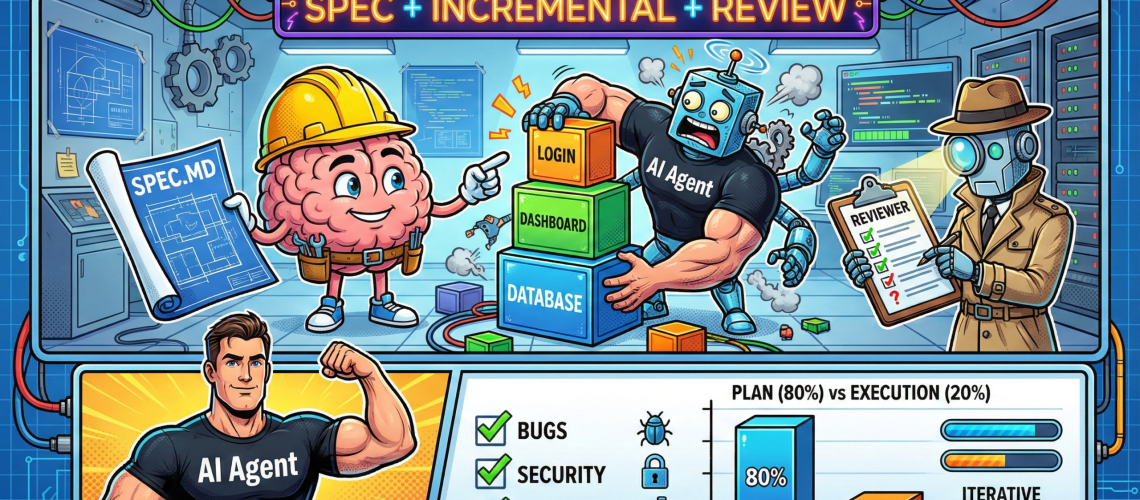
1. Build the “Source of Truth” (The Spec)
Before you open your code editor, use a high-reasoning LLM to create a Technical Specification. Don’t just ask for code; ask for a blueprint. This should include your folder structure, database schema, and the specific libraries you want to use. This becomes the “anchor” for your project.
2. The Rule of One (Incremental Builds)
Never ask an AI to “Build the whole app.” Even the best agents lose focus after a few hundred lines of code. Instead, feed the AI your Spec and ask it to complete one feature at a time.
Step A: Build the login page. (Test it).
Step B: Build the database connection. (Test it).
Step C: Build the dashboard. (Test it).
3. The “Reviewer” Audit
Once the project is “finished,” don’t ship it yet. Take your code and feed it to a different AI model. Ask it to be a “Senior Security Auditor” and find the flaws the first AI missed.
The Bottom Line
AI is a force multiplier, but 0 \times 100 is still 0. If your planning is zero, your result will be zero. Spend 80% of your time on the Specification and 20% on the Execution, and you’ll finish your projects in record time.
#Coding #AI #SoftwareDevelopment #TechTrends2026 #Programming #ArtificialIntelligence